One trace element, two sides – and what that means for our lives with Parkinson’s
When we talk about Parkinson’s disease, most conversations naturally revolve around dopamine, movement, exercise, and medication. Iron, by contrast, rarely takes center stage. And yet this small trace element plays a central – and deeply paradoxical – role in human biology, particularly in the brain.
Iron is essential for life. But in the wrong place, or in excessive amounts, it can become harmful. Nowhere does this delicate balancing act become more visible than in Parkinson’s disease.
Why iron is indispensable for our bodies
Iron accounts for only a tiny fraction of our total body weight. Despite this, life without iron is simply not possible. It is involved in countless processes that keep our cells, organs, and nervous system functioning.
Iron is crucial for oxygen transport via hemoglobin in red blood cells and energy production in the mitochondria, which are the “powerhouses” of our cells. It is crucial for synthesis of neurotransmitters, including dopamine, serotonin, and norepinephrine, DNA repair and cell division and immune defense and resistance to infection.
When iron levels are too low, the consequences are often felt quickly: fatigue, weakness, reduced stamina, and difficulty concentrating. These are symptoms that many people with Parkinson’s already struggle with – and iron deficiency can quietly amplify them.
The Brain and Iron in Parkinson’s Disease: High Demand, High Vulnerability
Although the brain makes up only about 2% of body weight, it consumes around 20% of the body’s oxygen. Iron is also essential here: it supports the transmission of nerve impulses, the formation of myelin – the protective sheath around nerve fibers – and it supports learning processes, memory, adaptability (neuronal plasticity), and dopamine production.
Hence, no iron means no dopamine. And yet, this is exactly where iron’s darker side begins to emerge.
Oxidative Stress: When Iron Becomes Harmful in Parkinson’s
Iron is chemically highly reactive. Its ability to switch between two states (Fe²⁺ and Fe³⁺) allows it to drive vital biochemical reactions – but this same property also makes it potentially dangerous.
When iron is not tightly controlled, free iron can generate highly reactive oxygen radicals. Through the so‑called Fenton reaction, extremely aggressive hydroxyl radicals are formed. These molecules can damage almost everything they encounter, including DNA, cell membranes, mitochondria and proteins.
Under normal circumstances, the body neutralizes this risk by binding iron to storage and transport proteins such as ferritin and transferrin. With increasing age – and particularly in Parkinson’s disease – this finely balanced system can begin to fail.
Iron and Parkinson’s: Focus on the Substantia Nigra
A growing body of research shows a consistent pattern: In Parkinson’s disease, brain iron accumulation, especially in the substantia nigra, is increasingly recognized as a key pathological feature.
This region of the midbrain is exactly where dopaminergic neurons, crucial for smooth and coordinated movement, progressively degenerate.
Recent reviews and imaging studies confirm that:
⚪Iron accumulation in the substantia nigra occurs early and progressively
⚪Higher iron levels are associated with greater neuronal loss and more severe symptoms
A Dangerous Triangle: Iron, Dopamine, and Alpha‑Synuclein in Parkinson’s Disease
A particularly compelling framework comes from the work of Rachel M. Wise and colleagues, based in Munich and New York. Their research highlights a toxic interaction at the heart of Parkinson’s pathology:
Iron + dopamine + alpha‑synuclein = a neurotoxic environment
Rachel M. Wise et al. describe how:
⚪Iron accelerates the oxidation of dopamine
⚪This leads to the formation of highly reactive dopamine byproducts
⚪Alpha‑synuclein misfolds more easily and aggregates
Together, these processes likely explain why dopaminergic neurons are uniquely vulnerable in Parkinson’s disease.
Iron Deficiency in Parkinson’s Disease
As contradictory as it sounds, many people with Parkinson’s disease simultaneously have low iron levels in their blood. This is very often combined with reduced appetite, constipation and slowed gastric emptying, impaired intestinal absorption and interactions with Parkinson’s medications.
It is known, that Iron deficiency can worsen fatigue, physical and cognitive performance, susceptibility to infections and concentration and attention.
Iron Interactions with Levodopa and Entacapone
Levodopa and entacapone are very commonly used medications for the treatment of Parkinson’s disease. Iron and levodopa share the same transport pathway in the intestine. When taken together, iron can bind to levodopa and significantly reduce its absorption.
Practical recommendation: To avoid interference with medication effectiveness, iron supplements or iron‑rich meals should be taken at least two hours apart from levodopa. This time separation helps ensure optimal absorption of levodopa and more stable symptom control.
Regarding entacapone, more recent research shows that it binds iron in the gut, may promote long‑term iron deficiency and may promote long‑term iron deficiency.
Iron Chelation – Hope, but no Breakthrough
Medications like deferiprone can remove excess iron from the brain. Clinical studies have demonstrated a measurable reduction in iron deposits. Despite this biological effect, however, no consistent clinical benefit, such as a clear and sustained improvement in symptoms, has yet been proven. Furthermore, some treated patients experienced significant side effects that may limit the use of such substances.
What does this mean for Everyday Life?
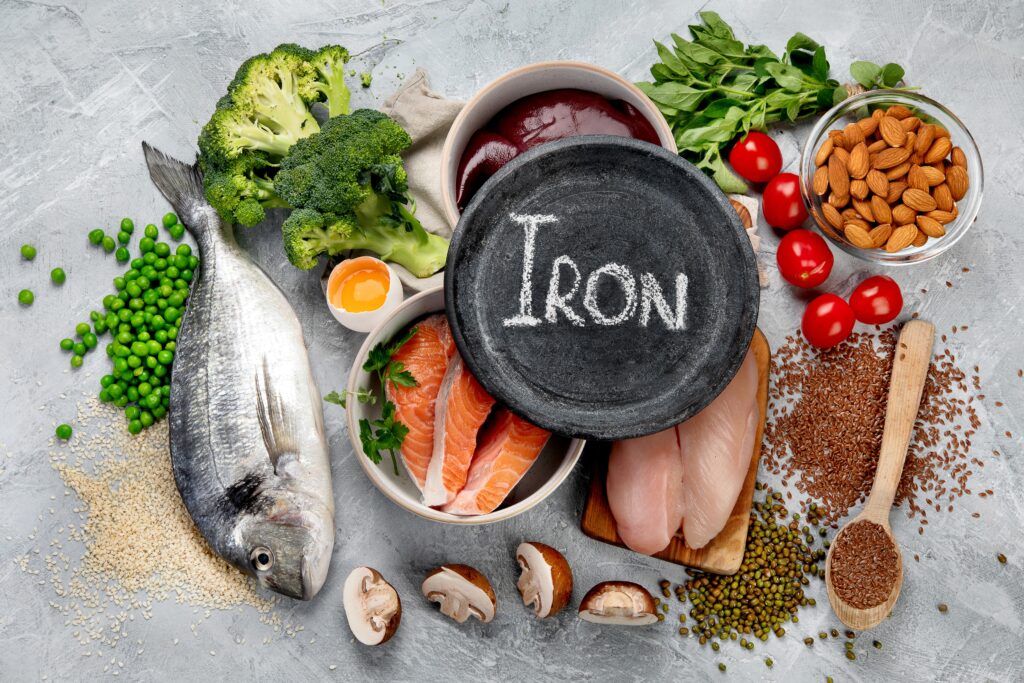
My practical recommendations are as follows: Iron levels should be checked regularly, especially ferritin, hemoglobin, and transferrin saturation. When iron is obtained through diet, plant-based sources such as legumes, nuts, seeds, and dark green leafy vegetables are preferable. Combining iron supplements with vitamin C can improve absorption in the intestines. It is also important to always take iron separately from Parkinson’s medications, as it can interfere with their effectiveness. Iron supplements should not be used preventively or “just in case,” but only in cases of a clearly diagnosed deficiency and with a corresponding medical recommendation.
My Conclusion: Balance instead of Extremes
When it comes to iron, the issue is not simply more or less. It is about location, timing, and balance. For people living with Parkinson’s, this means:
⚪Iron is essential
⚪Too much iron in the brain can be harmful
⚪Too little systemic iron can also be harmful, even while the brain shows iron accumulation.
The better we understand this dual role, the closer we come to truly individualized, safe, and effective care. And for me, both as a nurse and as someone who walks alongside people living with Parkinson’s every day, iron has become a powerful reminder that this disease is rarely about simple answers – but about learning, again and again, to respect the fine balance our bodies are striving to maintain.
Further links:
🔗Nigrostriatal iron accumulation in the progression of Parkinson’s disease (Nature, 2025)
🔗Iron Deposition in Parkinson’s Disease: A Mini-Review (Springer, 2024)
🔗FAIR PARK II study (NEJM). Trial of Deferiprone in Parkinson’s Disease.